
Your Database Should Be Working While You Sleep

This blog is co-authored by Iga Januszek, Dave Stone, and Purnima Phansalkar.
It’s 2:17AM. A DBA jolts awake to their phone screaming. Latency is spiking. An application is timing out. Somewhere, a production system is failing and somewhere else, a customer is noticing.
They drag themselves to a laptop, bleary-eyed, pulling up dashboards they’ve looked at a hundred times before, running queries they’ve run a hundred times before. Their manager is now awake too, firing off messages. The on-call developer is looped in. The war room fills up. An hour passes. Maybe two.
By morning, the immediate crisis is resolved, but the damage is done. Not just to the application. To the team. To the trust. To the goodwill that took months to build with the business. And somewhere in the back of everyone’s mind is the same quiet, exhausting thought: this is going to happen again.
This isn’t a story about a bad night. It’s the operating reality for database teams managing Postgres at scale, and it’s exactly the problem EDB Agentic Database was built to end.
The Problem Nobody Wants to Say Out Loud
Database teams are stretched thin and burning out quietly. Provisioning, patching, tuning, and incident response eat up hours that could go toward architecture, innovation, and the work people actually got into this profession to do.
“Provisioning and patching is a burden we want to get rid of.” - EDB customer
And it’s not just internal pressure. By 2028, Gartner expects spend on databases with embedded AI capabilities to triple. Your customers’ expectations are shifting, they’re looking for a cloud-like operational experience, whether they’re on-prem, in a hybrid environment, or moving off managed cloud services. The question isn’t whether automation comes to the data layer. It’s whether your customers are ready for it.
What Is an Agentic Database?
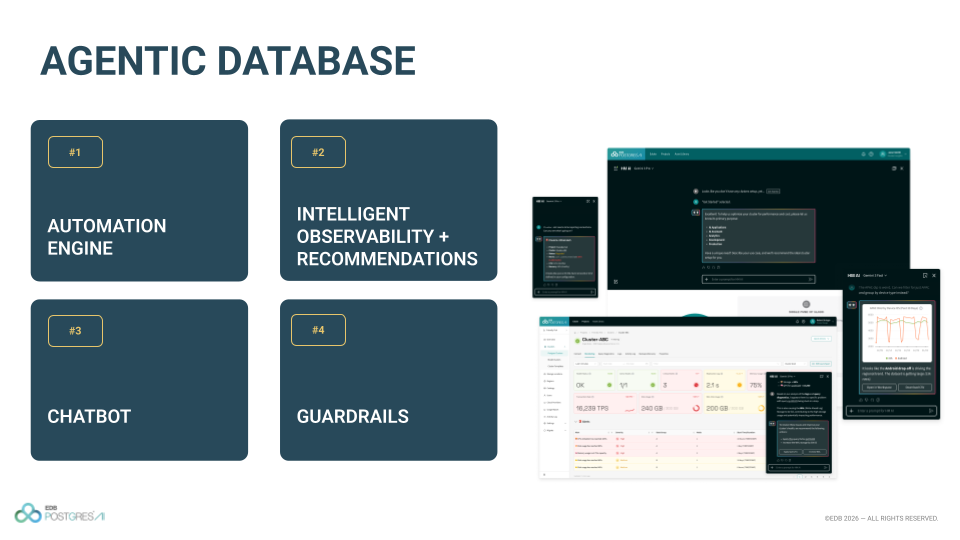
Agentic Database is an autonomous, always-on Postgres database that continuously automates lifecycle management and optimises workloads, acting inside enterprise guardrails. It’s built around three core pillars:
1. Automation Engine: The database self-tunes, self-scales, and self-heals. A full optimisation loop is embedded natively in the platform, no external tool, no separate monitoring layer, no added complexity.
2. Intelligent Recommendations: Actionable insights powered by over 20 years of deep Postgres expertise. The system surfaces proactive tuning suggestions before issues become incidents, and flags performance regressions and security gaps in real time.
3. Guardrails for Control: This is the piece that matters most in regulated and compliance-heavy environments. Every automated action operates within customisable permissions. Teams can start with recommendations, move to approvals, and progress to full automation when they’re ready. Nothing executes without permission and there’s a full audit trail of every action taken.
Think of it as your DBA agent: it observes database performance, reasons about what needs to change, and takes supervised or autonomous action without requiring manual intervention for routine operations.
The Business Value: What This Unlocks for Your Customers
The value conversation looks different depending on who you’re talking to, but the emotional thread running through all of it is the same: relief. The relief of not being the one responsible for everything going wrong at once.
For Platform Engineers and SREs, the biggest gift isn’t automation, it’s sleep. Alert fatigue and 3AM pages become the exception rather than the rule. Proactive detection and autonomous self-healing means problems are addressed before they reach a human. The team moves from reactive firefighting to strategic oversight, and the chronic low-grade stress of “what’s going to break tonight” starts to lift.
For Developers and App Teams, it’s freedom from a dependency they never wanted to own in the first place. The database handles itself. Developers get the full flexibility of Postgres without needing to be Postgres experts and the sprints that used to slip because of a database issue they didn’t know how to debug? Those come back.
For Decision Makers, the conversation is about confidence. The confidence to scale without proportionally scaling headcount. The confidence to tell the board that compliance and governance are built in, not bolted on. And the confidence that when something does happen, there’s an audit trail, not a blame game.
Technical Validation: How It Actually Works
Remember that 2AM scenario? Here's how it plays out differently with Agentic Database.
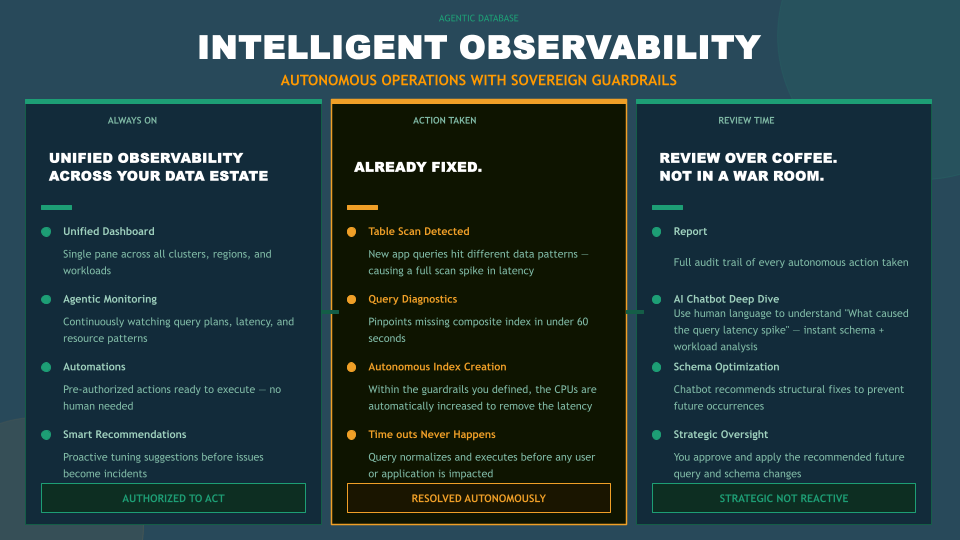
A new application deployment introduces queries hitting different data patterns, causing a full table scan and a latency spike. Here's what happens, without anyone being woken up:
- Agentic Monitoring continuously watches query plans, latency, and resource patterns across the full data estate.
- Query Diagnostics pinpoints the missing composite index in under 60 seconds.
- Autonomous Index Creation executes within the guardrails already defined, the fix is applied before any user or application is impacted.
- A full audit report of every autonomous action is waiting in the morning.
The DBA's phone doesn't ring. The war room, once a site of constant triage, now sits in an unaccustomed stillness. The manager sleeps through the night. And the DBA reviews what happened over their morning coffee, not in a state of adrenaline-fuelled crisis management.
It's worth noting that autonomous actions, including scaling CPU and memory, operate within guardrails that your team defines upfront. You decide what the system is authorised to do, when, and under what conditions. That means the automation works for you, not around you, and nothing happens outside the boundaries you've already signed off on.
This same autonomous loop applies to CPU and memory scaling, minor version upgrades, automated backups with continuous recovery validation, and security governance including transparent data encryption and audit logging.
Built for the AI Era Too
There's a second dimension to Agentic Database worth understanding: it's also built for AI agents, not just as one.
Think about where we're headed. Agents are already making decisions, triggering workflows, and acting on data at a speed and scale no human team could match. That's the point. The promise of agentic AI is that it handles the work humans shouldn't be spending their time on, the repetitive, the reactive, the relentless. But that promise only holds if the database underneath can keep up with the demand those agents create, and manage itself well enough that it doesn't become the bottleneck.
As your customers build agentic applications and LLM-powered workflows, they need a database that can serve as the intelligence layer - one that isn't waiting on a DBA to tune it every time an agent spins up a new workload, scales unexpectedly, or queries a dataset it's never touched before. Agents working with agents to do the work means the database has to be an active participant in that system, not a passive store that humans have to babysit in the background.
EDB Postgres AI is built for exactly that world. Native vector storage delivers up to 4.22× faster queries per second than comparable solutions, and as the first database provider with an open Model Context Protocol (MCP) interface, it enables reliable, context-aware interactions between any LLM and your data. Operational data and AI data live in one engine, meaning agents query where the data actually is, without translation layers or latency overhead.
The result: your customers' agents get a database that can keep up with them. And your customers get to stop keeping up with the database.
Where Customers Are Putting It to Work
Against AWS RDS/Aurora: EDB is hybrid. Customers own their data infrastructure with no cloud lock-in and full sovereign deployment support on-prem, air-gapped, or hybrid.
Against Oracle Autonomous DB: EDB delivers autonomous operations on open Postgres, with Oracle-compatible Postgres for migration scenarios. No proprietary lock-in, no OCI dependency.
Against self-managed Postgres stacks: Homegrown automation and fragmented tooling can’t match a unified control plane with a native optimisation loop. EDB replaces the patchwork with one platform.
Ready to See It in Action?
The best way to understand Agentic Database is to see it running. Check out the Agentic Database Demo to watch EDB Postgres AI detect, recommend, and resolve issues without manual intervention, or with human approval when you want it.
Agentic Database becomes a foundational part of every transactional database conversation starting with the June GA release. If your customers are managing Postgres at scale, dealing with operational overhead, or moving off cloud managed services, this is the conversation to be having.
An always-on Postgres® database that runs itself on your terms, it self-tunes, self-scales, and self-heals - Every action inside the guardrails you set. It’s available now! Talk to an expert today!